In June 2002, the Federal Trade Commission wrote to the major search engines with an instruction that sounds obvious now. If a website has paid to rank higher, the letter said, the result “should be clearly labeled as such using terms conveying that the ranking is paid for.”
Twenty-four years later, the label is still there. Almost everything else about it has gone.
The background shading is gone. The colored box is gone. The border is gone. As of October 2025, even the per-advertisement label is gone, replaced by a single header sitting above a group of ads that a user can collapse. Each of those changes was small. Taken together they describe a steady, decade-long retreat from exactly the kind of visual separation regulators asked for twice.
What makes this worth documenting is that consumers appear to have got better at spotting ads anyway. That is not the result most people assume, and it is the part nobody has measured properly.
What the regulators asked for
The FTC’s involvement began with a complaint. In July 2001 the consumer group Commercial Alert filed against eight search companies, arguing that paid placement was being passed off as editorial ranking. The FTC’s response, a letter dated 27 June 2002 from Heather Hippsley, then Acting Associate Director of the Division of Advertising Practices, did not bring an enforcement action. It did set an expectation.
The reasoning was about consumer expectation rather than about advertising in itself. People approach a search engine expecting results ordered by relevance. Any departure from that, the Commission held, requires disclosure. Labels then in use, including “Products and Services” and “Featured Listings,” were judged too vague to do the job.
Eleven years later the FTC wrote again, and the second letter is the more revealing of the two. Dated 24 June 2013, it opens by noting a decline in compliance since 2002, and it is unusually specific about design. Search engines should use “more prominent shading that has a clear outline,” or “a prominent border,” or both. The text label should use “language that explicitly and unambiguously conveys if a search result is advertising,” should be “large and visible enough for consumers to notice it,” and should sit “immediately in front of an advertising result, or in the upper-left hand corner” rather than tucked into a top-right corner where people do not look.
Read that list against a Google results page today. Shading, absent. Outline, absent. Border, absent. A label large enough to notice, arguable. In the upper-left corner, technically yes, though now describing a block of ads rather than any single one.
What actually happened to the label
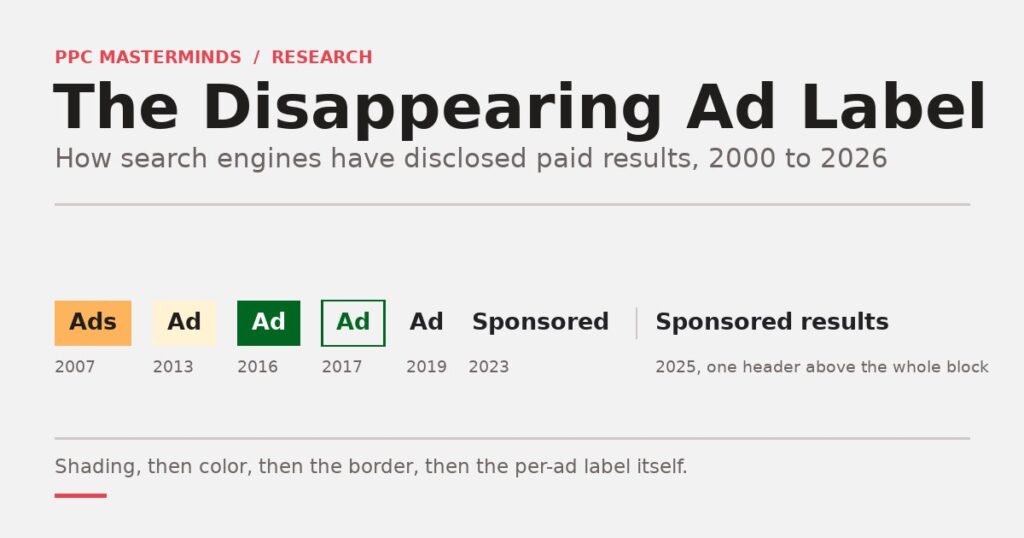
The visual history is well documented, and it runs in one direction.
| Year | What the ad looked like |
|---|---|
| 2007 | Background shading, changed from blue to yellow |
| 2008 to 2012 | Shading retained, color repeatedly tested: green, bright blue, violet, back to yellow |
| 2013 | Yellow shading made paler, then background shading dropped altogether; a yellow “Ad” label appears next to each text ad |
| 2014 | The yellow “Ad” label goes global, in a smaller size |
| 2016 | The label turns green, matching the display URL color used by ads and organic results alike |
| 2017 | The solid green background is removed, leaving green text inside a thin green border |
| 2019 | The label turns black, the display URL turns black to match, and the border is removed entirely |
| 2022 | On mobile, “Ad” becomes “Sponsored” |
| 2023 | “Sponsored” becomes bold black text |
| 2025 | Per-ad labels are replaced by a single “Sponsored results” header above the whole ad block, with an option to hide the section |
Two things stand out. The first is that the abandonment of background shading in 2013 happened in the same year the FTC asked for shading with a clear outline. The second is that the 2019 change did not simply remove the border; it recolored the display URL to match the label, so that the last remaining chromatic difference between a paid result and an unpaid one disappeared.
Google’s side of this deserves stating. Mobile screens are small, colored blocks eat vertical space, and a design language that stays consistent across billions of daily queries has its own logic. The black label reached mobile before desktop for exactly that reason. None of that changes what the sequence adds up to.
What consumers actually report
Here is where the received wisdom turns out to be wrong, and where we have our own data.
The early numbers were poor. A Pew Research Center report published on 23 January 2005 found that only 38 percent of search engine users were even aware that there were two different kinds of result. Of that 38 percent, 47 percent said they could always tell which results were paid. That works out at roughly one searcher in six who both knew the distinction existed and was confident of spotting it.
The 2013 picture had not improved enough to satisfy anyone. Consumer Reports published a study that year, “Searching for Disclosure,” examining how search engines alert consumers to advertising in results. The FTC’s own 2013 letter cites research finding that close to half of searchers did not recognize the top ads as advertising at all. That evidence is what prompted the second letter.
In 2022 we ran our own survey of 1,013 US consumers to see where the number had landed. We asked a deliberately plain question:
When you search Google, can you tell which results are paid ads and which aren’t?
The options offered were “Yes, I think it’s clear,” “I’m often not sure,” “It’s pretty hard to tell,” and “I don’t really care.”
Seventy-three percent said paid results are clearly marked. Six percent said it is pretty hard to tell.
Set that beside the 2005 Pew finding and the change is substantial. Set it beside the visual timeline above and it is genuinely counterintuitive, because the label was less visually distinct in 2022 than at any prior point in the period, and recognition was nonetheless far higher.
The honest reading of that gap
There is a comfortable conclusion available here and we should not reach for it. The comfortable version says design does not matter, because people learned to spot ads regardless. That is probably too strong.
A more careful reading is that the three measurements are not strictly comparable. Pew in 2005 asked whether people were aware two kinds of result existed. Our 2022 question asked whether paid results are clearly marked. Those are different questions, and self-reported confidence is not the same thing as demonstrated ability. Somebody who believes they can spot every ad and cannot will answer “yes, I think it’s clear.”
What the numbers support is narrower and still interesting: over roughly two decades, and across a period when search engines steadily reduced the visual distinction between paid and unpaid results, the proportion of American consumers who say they can tell the difference went up rather than down. The most likely explanation is familiarity. A generation that has never used a search engine without ads in it does not need a yellow box to know where the ads are.
That explanation has an uncomfortable corollary for anyone designing disclosure. If recognition is carried by habit rather than by design, then the moment the format changes, recognition should be expected to fall until habit catches up again.
Which brings us to 2026.
Advertising moves inside the assistant
Ads began appearing inside ChatGPT for logged-in adult users on the free tier in February 2026, and Google introduced advertising formats that appear within AI Mode responses rather than beside them. Both are labeled. Neither has the twenty-five years of user familiarity that carries ad recognition in a conventional results page.
The disclosure problem is also structurally different. In a list of ten blue links, an ad is a discrete item that can be shaded, bordered or labeled. In a generated paragraph that answers a question, the boundary between the answer and the commercial content is a harder thing to draw, and a label sitting above the block does not obviously tell a reader which sentence was paid for.
Nobody has published consumer data on whether people can tell. The FTC’s 2002 reasoning applies with more force here than it did to the case it was written about, because the expectation that the response is ordered by relevance rather than by payment is, if anything, stronger when the response is phrased as an answer.
That is the open question this piece ends on, and it is a real one. Every measurement quoted above describes a page of ranked links. None of them describes a paragraph. Until somebody asks the question of a representative sample, anybody claiming to know how consumers read advertising inside an AI assistant is guessing.
Methodology
The figures cited above come from a survey of 1,013 United States consumers commissioned by PPC Masterminds, fielded through SurveyMonkey in January 2022 and published on the 28th of that month. Respondents were screened to adults resident in the United States who use a search engine. Question wording and answer options are reproduced verbatim in the relevant sections above, in the order they were presented, because option order affects response distribution and a reader checking our work should be able to see exactly what was asked.
Sources
- Federal Trade Commission, letter to Gary Ruskin of Commercial Alert, 27 June 2002. Read the letter
- Federal Trade Commission, “Sample Letter to General Purpose Search Engines,” 24 June 2013. Read the letter
- Pew Research Center, “Search Engine Users,” Part 5, 23 January 2005. Read the report
- Consumer Reports, “Searching for Disclosure: How Search Engines Alert Consumers to the Presence of Advertising in Search Results,” 2013. Read the study
- Search Engine Land, “A visual history of Google ad labeling in search results.” Read the history
- TechCrunch, “Google is updating its ad tag to ‘Sponsored’ for mobile search,” 14 October 2022. Read the report
- Search Engine Land, “Google Ads label is now a bold black text Sponsored label,” 2023. Read the report
- Search Engine Journal, “Google Redesigns How Search Ads Are Labeled,” 14 October 2025. Read the report
- PPC Masterminds, “What Users Think About Google Ads,” 2022 survey of 1,013 US consumers. Read the survey
Ready to put this into practice? Learn more about our professional PPC management, no contracts, transparent monthly pricing.
Request Free Audit
Zaid is a leading expert on data driven digital marketing; focusing on analytics and actionable insights from data. Founder of PPC Masterminds with years of experience, speaker and trainer. A contributor to Forbes, he is consistently building masterpiece data driven digital marketing campaigns focused on improving ROI.